Bruce Lee – Equipment Manager
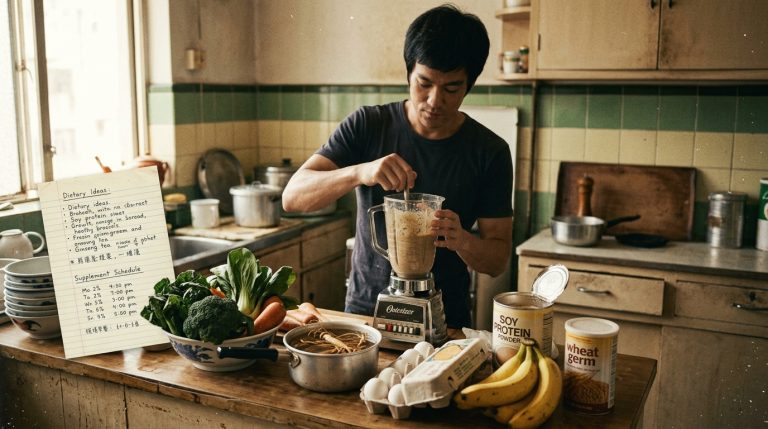
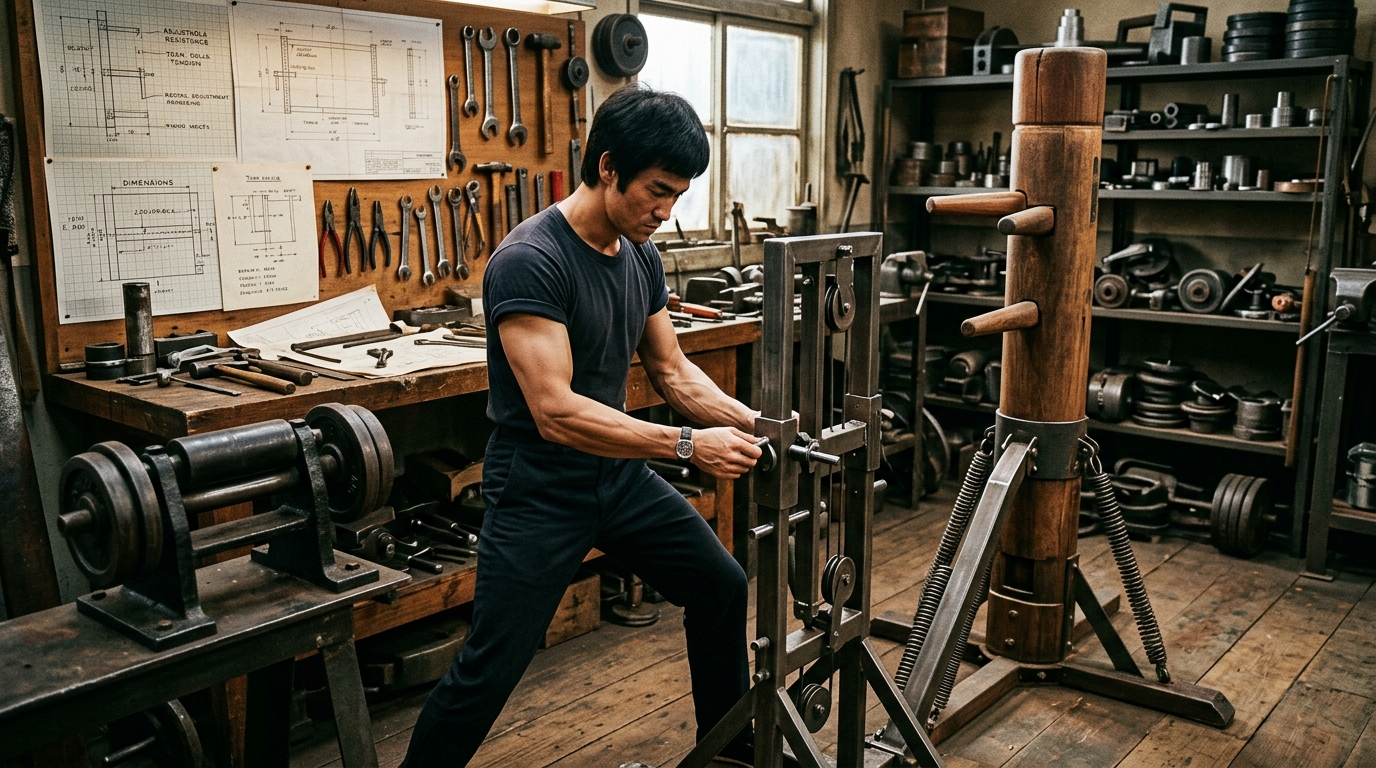
In 1961, Bruce Lee was 20 years old, living in Seattle, and managing athletic equipment for the University of Washington’s sports department. He handled gear, maintained inventory, arranged kit for various teams, and received in exchange a small stipend and accommodation on campus. It was exactly as unglamorous as it sounds.
It was also one of the most intellectually productive periods of his life.
How He Got There
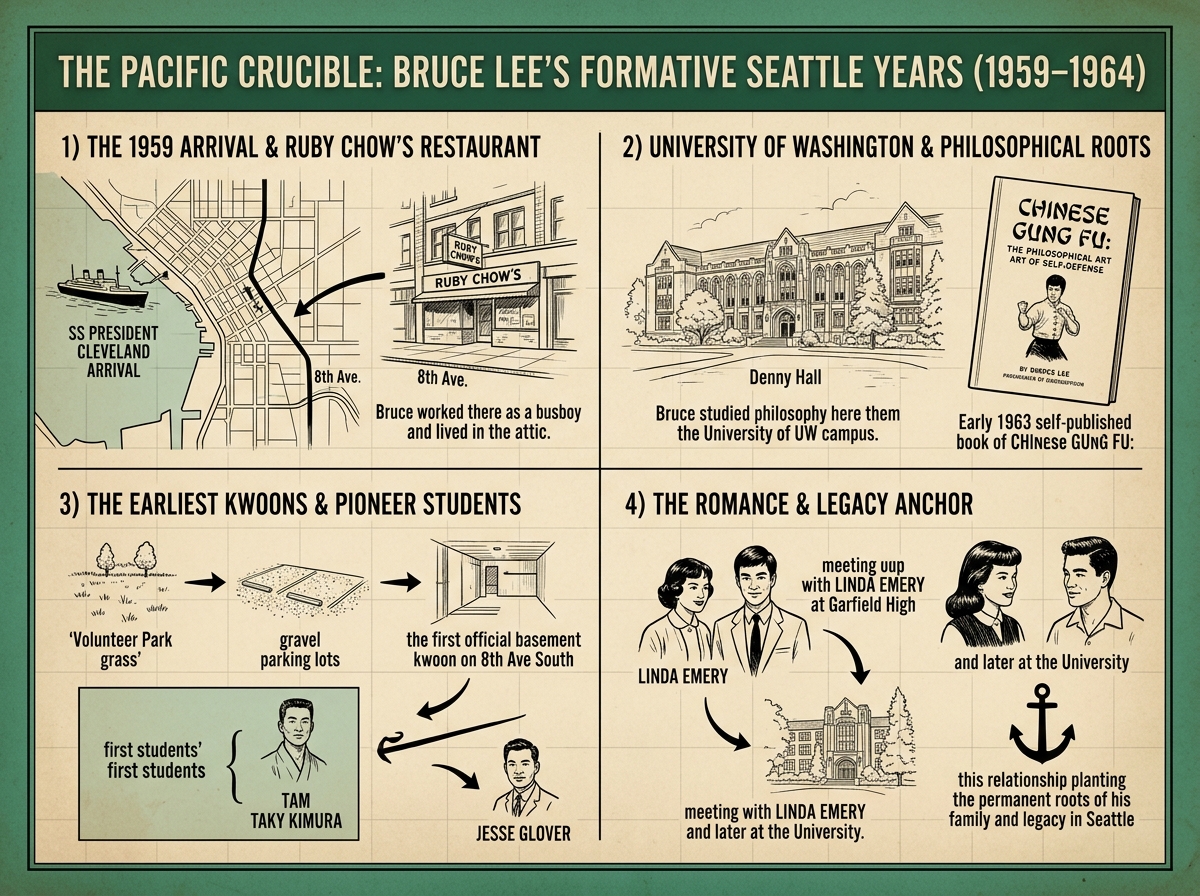
Lee arrived in Seattle in 1959, sent back to the United States by his father, who had grown alarmed at the frequency and severity of the street fights his son was getting into in Hong Kong. Lee was 18, had a small amount of money, some English from his years at St. Francis Xavier’s College, and a fierce determination to make something of himself that was entirely undefined at that point.
His first two years in Seattle were improvised. He taught Cha-Cha dancing — he had won the 1958 Hong Kong Cha-Cha Championship, one of the more unexpected facts in his biography — and worked as a waiter at Ruby Chow’s restaurant, a Seattle institution run by a family friend. In 1961 he enrolled at the University of Washington as a drama student. The equipment manager position came through the university’s work-study system: housing and a modest income in exchange for managing the athletics department’s gear.
What the Job Actually Involved
The specifics of what an equipment manager does at a university athletics department haven’t changed much since 1961. You receive gear, maintain it, issue it to athletes and coaches, track what goes out and what comes back, clean and repair as needed, and arrange logistics around practice schedules and competitions. It requires organization and reliability. It does not require genius.
What the position gave Lee was access. The university’s athletics facilities were available to him during off-hours. The sports science resources — modest by contemporary standards, substantial by the standards of 1961 — were available to a curious, self-educating person with time and motivation. He was working around coaches and athletes who took physical performance seriously, some of whom became interested in what he was doing in the parking lot.
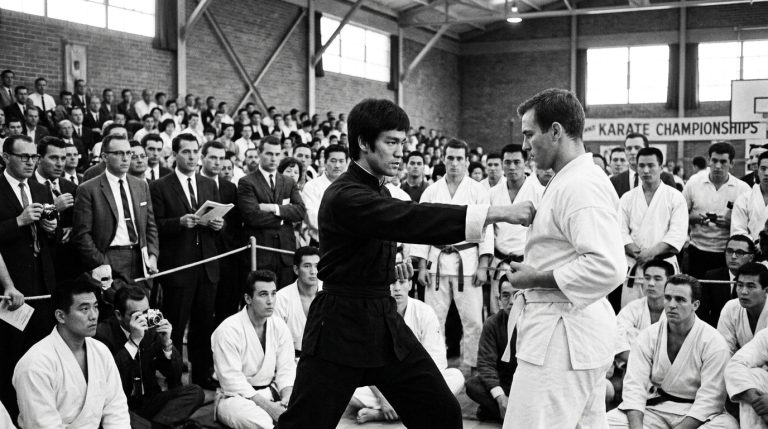
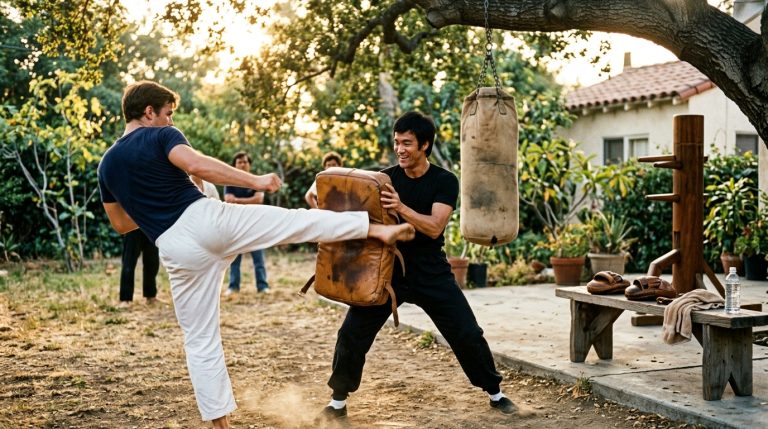
That parking lot practice is where the story gets interesting. While managing towels and tracking equipment by day, Lee was teaching Gung Fu to fellow students in the evenings — informally at first, in whatever space was available, eventually in small rooms around campus that the university informally tolerated. This operation would become the foundation of his first formal teaching organization: the Jun Fan Gung Fu Institute, which he opened in Seattle in 1963.
Taky Kimura
The most important relationship formed during the equipment manager period was with Taky Kimura, a Japanese-American man who attended one of Lee’s early demonstrations and immediately committed to the training. Kimura was older than Lee, had lived through the Japanese-American internment during World War II, and was working a job he found unfulfilling. He found in Lee’s teaching something that addressed a specific need he had for physical confidence and philosophical grounding.
The two became close friends. Lee recognized in Kimura both genuine dedication and a quality of loyalty that he trusted completely. When Lee eventually moved to Oakland and then Los Angeles, he left Kimura in charge of the Seattle Jun Fan school. Kimura ran it for decades, maintaining the curriculum and the standards, continuing to teach until he was well into his eighties. He maintained Bruce Lee’s grave at Lake View Cemetery as a personal responsibility.
It was the parking-lot teaching during the equipment manager years that created that relationship. Without the job that put Lee on campus, the relationship with Kimura might not have happened at all.
| Formative Dimension | Daily Living Reality | Key Relationships & Mentors | Foundational Impact on JKD |
|---|---|---|---|
| Employment & Subsistence | Busboy at Ruby Chow’s restaurant; later gymnasium custodian and equipment manager | Working grueling shifts while lodging in a tiny attic room | Forged relentless work ethic, humility, and physical conditioning habits. |
| Academic & Intellectual Study | Enrolled at University of Washington studying philosophy and dramatic arts | Intensive study of Western philosophy, physiological mechanics, and psychology | Supplied the intellectual scaffolding that transformed traditional Gung Fu into JKD. |
| The First Jun Fan Kwoon | Informal training sessions in public parks, gymnasiums, and basements | Taky Kimura, Jesse Glover, James DeMile, Doug Palmer | Tested Wing Chun mechanics against diverse body types, boxers, and streetfighters. |
| Personal Transformation | Public martial arts exhibitions and university lectures | Met Linda Emery (Cadwell) at Garfield High School demonstration | Established the lifelong emotional and professional partnership of his career. |
The Reading and the Thinking
This is the aspect of the Seattle years that gets least attention. Lee’s access to the university library during this period was extensive, and he used it. The reading he did between 1961 and 1964 — Krishnamurti, Alan Watts, René Descartes, Jean-Jacques Rousseau, Jiddu’s commentaries on consciousness — directly shaped the philosophical framework that would eventually become Jeet Kune Do.
This was not casual reading. Lee took notes obsessively. He copied passages. He wrote responses in the margins. The intellectual habits formed during the university years — the habit of treating any idea as something to be tested rather than accepted, the commitment to stripping away what didn’t work and keeping what did — are the same habits that produced his approach to martial arts. He was building the same thing simultaneously in two different domains: a fighting system and a philosophy of living.
The equipment manager job, which paid him just enough to stay in Seattle, bought him the time to do both.
I have always been a martial artist by choice, an actor by profession, but above all, a student of life.
Bruce Lee, Personal Reflection
Meeting Linda
In 1963, a student named Linda Emery attended one of Lee’s Gung Fu demonstrations at the university and stayed to ask questions. She was 17. He was 22 and teaching with a confidence that made no sense given his job title and circumstances. They married in 1964.
Linda later described the contradiction she observed in those early years: a young man managing athletic equipment and folding towels who was simultaneously reading Descartes, teaching a martial art he was actively inventing, and operating with complete certainty that he was going to be something significant. “There was never a moment when he doubted himself,” she said in a 1975 interview. “I don’t know where that came from. But it was completely real.”
The equipment manager job was a circumstance he moved through. The reading, the teaching, the building of relationships with people like Kimura — those were what he was actually doing during those years, in whatever time the job left him. The gap between the role on paper and the interior life he was living through it is one of the more striking contrasts in his biography. It tells you something about how he understood the relationship between circumstances and identity: the circumstances were temporary and manageable; the identity was what he was actively constructing.
He left Seattle in 1964. He never came back to live there. But he chose to be buried there, which is its own kind of statement about what those years meant to him.