The Mystery of Bruce Lee’s Death
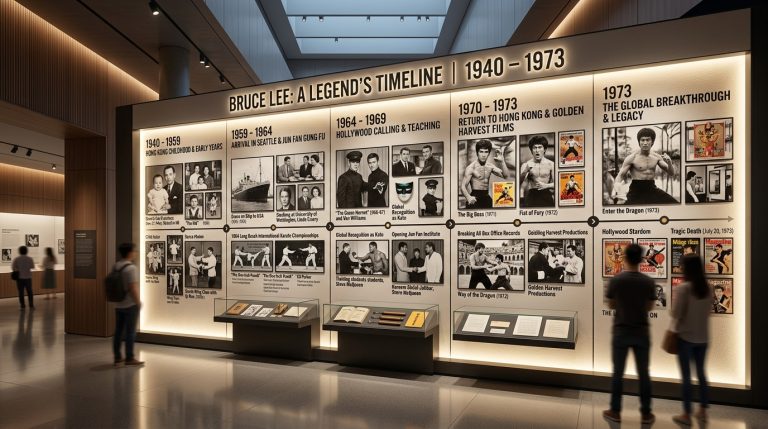
Six days. That’s the gap between the date Bruce Lee died and the date his most famous film opened in American cinemas. On July 20, 1973, he was pronounced dead at Queen Elizabeth Hospital in Hong Kong. On July 26, 1973, Enter the Dragon opened across the United States. The film he’d spent years working toward, the one that was supposed to change everything, arrived after he was already gone.
He was 32 years old. He appeared to be in extraordinary physical condition. And the circumstances of his death have been debated, theorized about, and medically re-examined for more than fifty years without producing a consensus that fully satisfies everyone who has looked at the evidence.
The Official Account
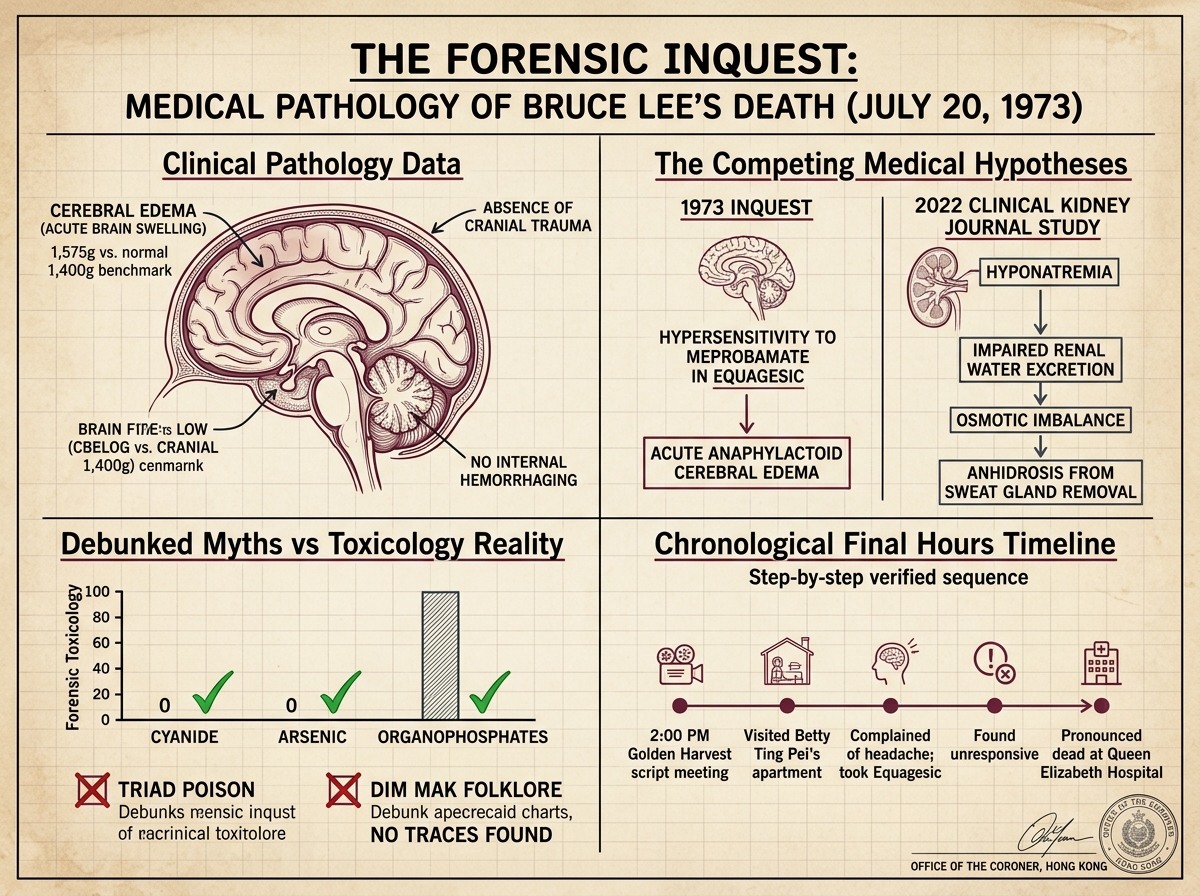
On the afternoon of July 20, Lee met with producer Raymond Chow at the apartment of actress Betty Ting Pei in Kowloon to discuss the script for Game of Death. At some point during the meeting, Lee complained of a headache. Ting Pei gave him an Equagesic tablet — a painkiller containing meprobamate (a tranquilizer) and aspirin, then widely prescribed for pain and muscle tension. Lee had taken Equagesic before without apparent adverse reaction.
He went to lie down in the bedroom. When Chow and Ting Pei checked on him and could not rouse him, an ambulance was called. Lee was transported to Queen Elizabeth Hospital, where he was declared dead. He showed no signs of external injury. The initial cause of death listed was hypersensitivity to meprobamate — an allergic reaction that had caused acute cerebral oedema, or swelling of the brain.
The Hong Kong coroner’s inquest, completed in September 1973, returned a verdict of “death by misadventure” — accidental death resulting from a foreseeable but unintentional action. The Equagesic reaction was accepted as the proximate cause.
The May Collapse That Everyone Tends to Forget
What makes the official account complicated is what happened ten weeks earlier. On May 10, 1973, Lee was at Golden Harvest studios in Hong Kong, dubbing dialogue for Enter the Dragon, when he collapsed suddenly. He suffered seizures, lost consciousness, and was hospitalized with cerebral oedema — the same condition that would kill him in July.
Doctors ran extensive tests. They could find no definitive cause. Their recommendations: reduce workload, rest more, be less intense about training. Lee was notoriously bad at following medical advice that required him to slow down. He did not rest. He returned to an extraordinarily demanding schedule within weeks.
Two collapses involving identical brain swelling in a ten-week period, with no identified underlying cause, is the central unresolved problem in the medical history of Bruce Lee’s death. The official verdict addressed the July event in isolation. It did not — and at the time, could not — fully explain why a 32-year-old in exceptional physical condition had experienced two separate episodes of life-threatening brain swelling within the same year.
The Medical Theories: What Was Actually Proposed
Several hypotheses have been advanced by researchers and physicians over the decades. They vary considerably in their evidential support.
The kidney failure / hyponatremia hypothesis is currently the most medically credible. A 2018 paper published in the peer-reviewed journal Clinical Kidney Journal, authored by nephrologists Choi, Pak, Choi, and Choi, proposed that Lee had an underlying inability to excrete excess water — a condition called hyponatremia, or critically low blood sodium. The paper argued that chronic cannabis use, documented in Lee’s toxicology at the time of death, combined with very high water intake and an extremely low-sodium diet, may have impaired his kidney function to the point where fluid could not be properly regulated. Fatal brain swelling caused by hyponatremia would look identical to the oedema recorded in both the May collapse and the July death.
This theory gained significant media coverage. The lead author explicitly stated they were not claiming certainty — they were presenting it as a plausible mechanism that fit the documented facts better than a simple drug allergy. The hypothesis accounts for both collapse events, which the Equagesic theory alone cannot.
The sweat gland removal theory points to a procedure Lee underwent in early 1973, in which he had his sweat glands surgically removed for cosmetic reasons — specifically to improve his on-screen appearance by preventing visible perspiration during filming. The procedure was real and documented. Some researchers have proposed that eliminating the body’s primary cooling mechanism contributed to temperature dysregulation, potentially triggering the collapses. This remains speculative. There is no direct clinical evidence linking the procedure to cerebral oedema.
The overtraining and exhaustion hypothesis is not a single theory but a general observation: Lee was working at a pace that his own doctors repeatedly warned him was unsustainable. In 1973, he was producing, directing, writing, performing, and conducting intense daily training simultaneously. The physical and psychological load was extraordinary. Whether chronic exhaustion contributed to an underlying physiological vulnerability remains impossible to determine from existing evidence.
The “touch of death” and foul play theories have no credible evidential basis and are not taken seriously by anyone who has reviewed the medical record. They belong to the mythology that accumulated around Lee after his death, not to any serious analysis of it.
What Bruce Lee’s Toxicology Showed
The post-mortem toxicology found meprobamate — the active sedative component of Equagesic — and cannabis in Lee’s system. No other substances of note. This is important because it rules out several popular theories that circulated in the 1970s involving other drugs or poisons. The cannabis finding was consistent with regular use and was not at a level that would independently cause death in an otherwise healthy person.
The meprobamate finding supported the official verdict of drug hypersensitivity, but critics of that verdict have noted that meprobamate was a commonly prescribed medication with a well-documented side effect profile — and that acute fatal cerebral oedema as an isolated reaction to a standard dose was not a well-established mechanism at the time, and remains somewhat unusual medically.
Linda Lee’s Account
Linda Lee Cadwell, who was in Hong Kong during this period and who was called to the hospital on the night of July 20, has spoken about the events with both care and restraint in the decades since. She has accepted the official verdict while acknowledging that the full medical picture was never entirely clear. In her book Bruce Lee: The Man Only I Knew, published in 1975, she documented the events factually without advancing particular theories.
What she has emphasized consistently is that Lee was not hiding illness or vulnerability in his final months. He was genuinely optimistic about what was coming — Enter the Dragon was finished, he believed it would break through in Western markets in a way his previous films hadn’t, and he had specific plans for what came next. He died in the middle of a period he found genuinely exciting. The gap between his internal experience in those final weeks and the outcome is something she has described as the most bewildering aspect of the loss.
Where Things Stand Now
After more than fifty years, the most credible current position is roughly this: Bruce Lee had some underlying physiological vulnerability affecting fluid regulation — possibly related to kidney function, possibly to the combination of high water intake, a low-sodium diet, and cannabis use, possibly to other factors not yet identified. At some point in May and again in July 1973, something triggered a cascade that caused acute cerebral oedema. In July, he was alone and unconscious, and by the time he reached the hospital the damage was irreversible.
No foul play has ever been established. No single definitive cause has been proven beyond reasonable medical doubt. The official verdict — death by misadventure, drug hypersensitivity — is the conclusion that the available evidence most directly supports, while leaving open questions that the 1973 investigation did not have the tools to answer.
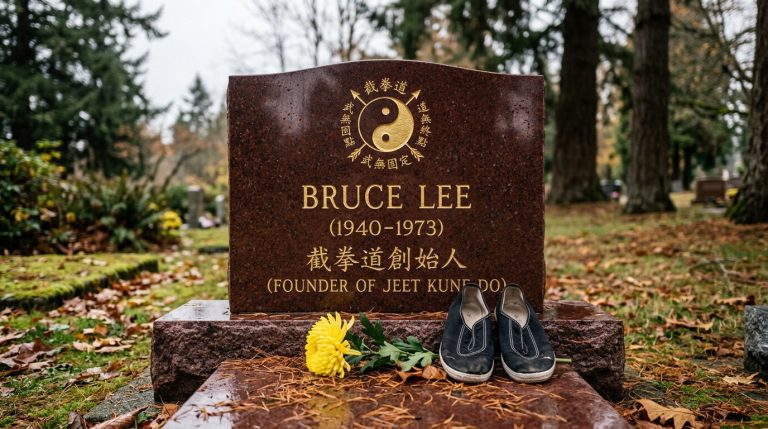
He was buried at Lake View Cemetery in Seattle on July 31, 1973. Brandon Lee, his son, was buried beside him twenty years later, after his own death on a film set at 28.