Training With Bruce Lee
James Coburn said it plainly in a 1970s interview: “He made me realize that everything I thought I knew about fighting was wrong.” Coming from Coburn — an actor who took martial arts seriously and had trained with several different teachers — this was not a polite compliment. It was a precise description of what happened in the room when you actually worked with Bruce Lee.
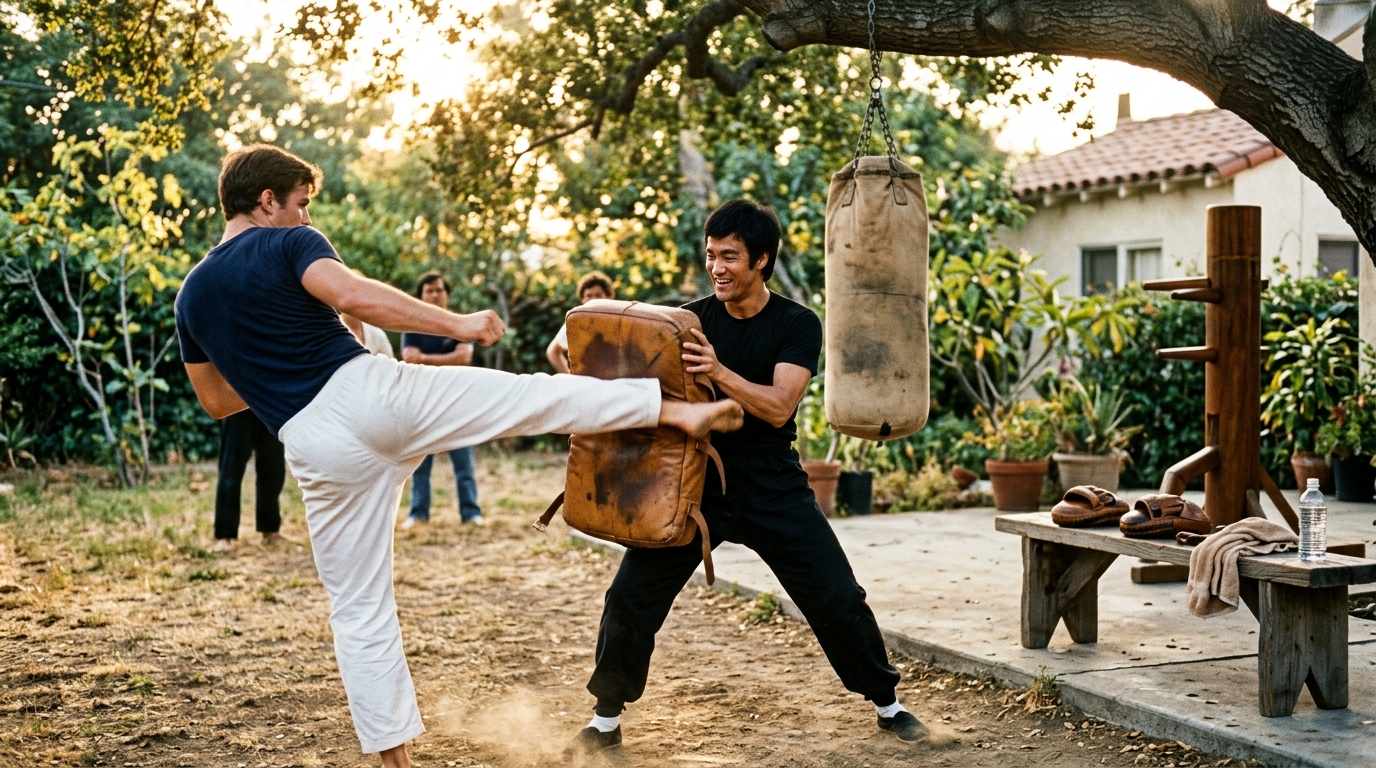
A significant number of Hollywood celebrities, professional athletes, and established martial arts champions trained personally with Lee during his Los Angeles years. Their accounts — gathered across decades of interviews — paint a consistent picture of what made him different. Not just as a fighter, but as a teacher.
James Coburn: The Philosophical Student
Coburn trained with Lee for several years and became one of his most committed students — not just in physical technique but in the underlying philosophy of Jeet Kune Do. The two men were intellectually compatible in ways that went beyond martial arts. Both were drawn to Eastern philosophy, to questions about the relationship between physical practice and mental clarity, to the idea that fighting was a vehicle for something larger.
“He taught me that the whole thing is a spiritual journey,” Coburn said. “The physical part was just the vehicle.” This isn’t the kind of thing you say about a sparring coach. It reflects a relationship that went much deeper than technique.
Coburn co-wrote the original screenplay for The Silent Flute with Lee and screenwriter Stirling Silliphant — a project conceived during their training sessions as a vehicle for Lee’s philosophy. The film was never made in their lifetimes; it was eventually produced as Circle of Iron in 1978, after Lee’s death, with David Carradine in the lead role. Coburn spoke about the lost original project with evident regret in later interviews.
Holistic Conditioning Model
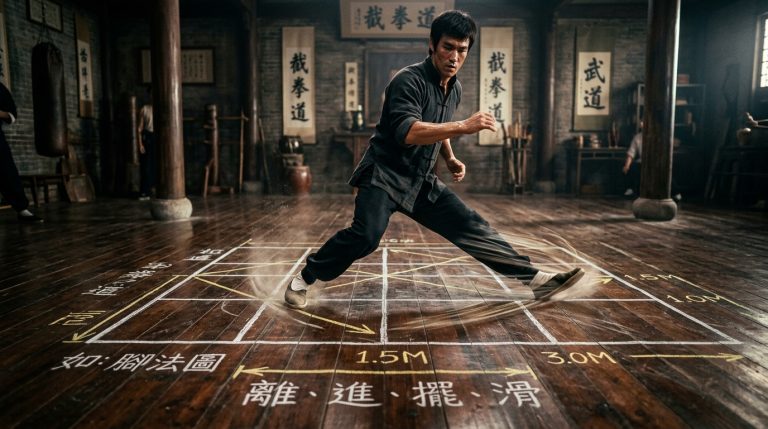
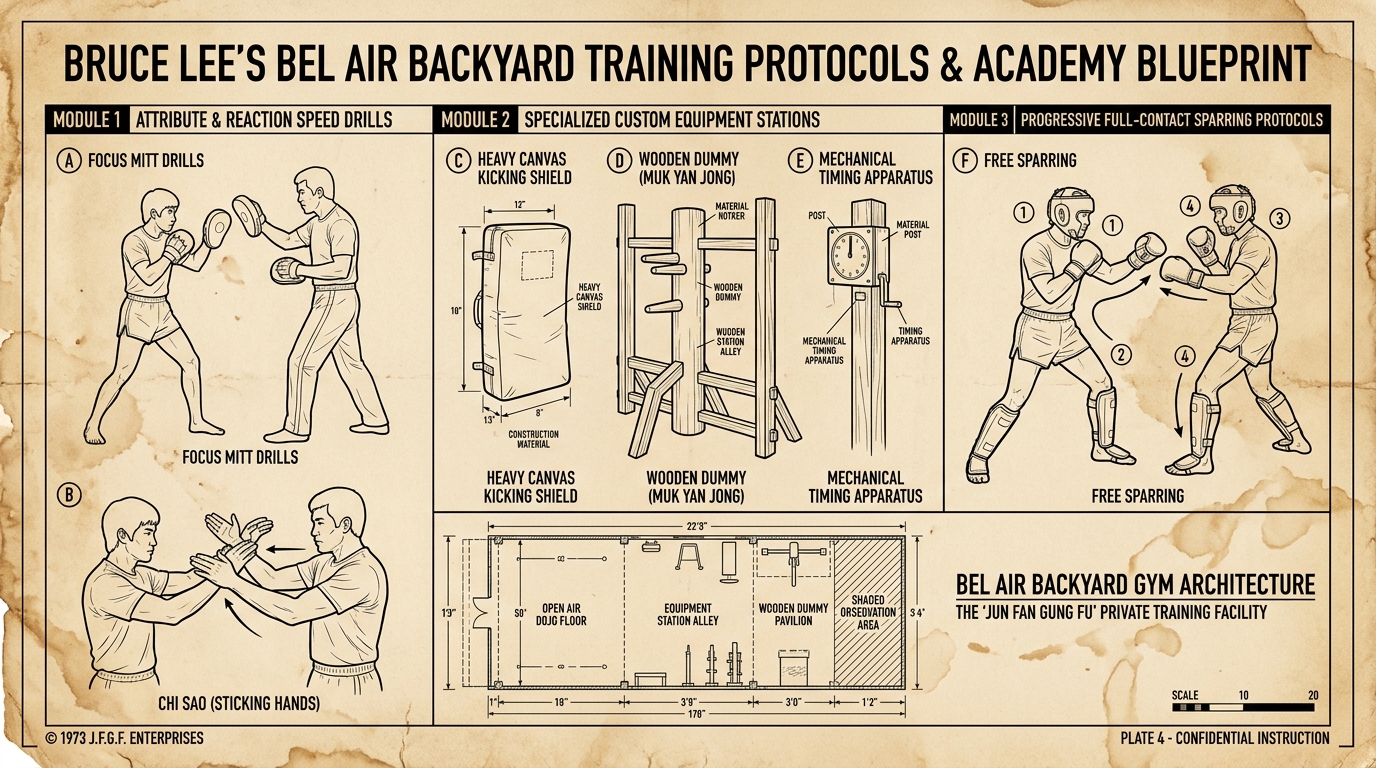
Students training with Bruce Lee quickly realized he rejected the traditional martial arts habit of only practicing katas. Technical mastery sat at the apex of a disciplined, layered pyramid:
Steve McQueen: The Competitive Student
McQueen began training with Lee in the mid-1960s, not long after Lee settled in Los Angeles. The sessions that followed were a study in two very different personalities finding common ground through physical excellence. McQueen was intensely competitive — he wanted techniques and results, not theory. He found Lee’s more philosophical approach initially frustrating. “What does this have to do with fighting?” he reportedly asked during early sessions.
Over time, that resistance softened. McQueen was too physically intelligent not to recognize what he was experiencing. Lee could make him feel — despite McQueen’s own considerable physical capability — like a beginner. Not by overpowering him, but by being somewhere unexpected, by making the techniques McQueen thought he understood completely ineffective.
McQueen later described Lee as “the most gifted martial artist I ever encountered” and continued training in the years after Lee’s death. He was also one of the pallbearers at Lee’s funeral in Seattle in 1973 — a fact that says more about the depth of the relationship than any interview quote.
Kareem Abdul-Jabbar: The Most Unexpected Student
The pairing made no logical sense on paper. Abdul-Jabbar was already one of the greatest basketball players in history when he began studying Jeet Kune Do with Lee in the early 1970s — a 7’2″ giant at the peak of a different kind of physical excellence. Lee was 5’7″ and roughly 135 lbs.
The dynamic that developed between them was genuine. Abdul-Jabbar later described Lee as someone who was intensely curious about the specific problem of fighting someone his size — not in the dismissive way that short fighters sometimes approach large opponents, but as a genuine engineering challenge. “He worked through it systematically,” Abdul-Jabbar said. “He wasn’t afraid of the size difference. He was interested in it.”
Their work together produced the extraordinary sequence in Game of Death that Lee had originally envisioned: a pagoda fight between radically different body types that showed Jeet Kune Do’s adaptability as a principle rather than a fixed set of techniques. The footage that exists from that production — much of it still unused when Lee died — shows two athletes who had clearly developed real mutual understanding through training. See the full breakdown in our Kareem and Game of Death article.
Chuck Norris: Mutual Respect Between Champions
When Norris began spending time with Lee, he was a world karate champion — not a casual practitioner. He had titles. He had trained under serious teachers. He was not someone who could be easily impressed by martial arts demonstrations.
What developed was less a student-teacher relationship than an exchange between two serious martial artists with different but overlapping knowledge bases. Norris had depth in traditional karate that Lee found genuinely interesting. Lee had a cross-disciplinary synthesizing approach that Norris found disorienting in the best way. Their sessions were competitive and respectful simultaneously — each man testing ideas against someone who could meaningfully push back.
Lee later cast Norris as the villain in Return of the Dragon specifically because he wanted the most credible possible opponent on screen. The Colosseum fight sequence became one of the most discussed in martial arts cinema. Norris has spoken in multiple interviews about what he absorbed from Lee’s approach to cross-training and adaptation — ideas that influenced how he thought about his own practice for years afterward.
Joe Lewis and Mike Stone: The Champions Who Changed
Both Lewis and Stone were full-contact karate champions when they encountered Lee. Lewis in particular — who would go on to be considered by many historians as the greatest American full-contact karate fighter of his era — credited Lee with transforming his approach to fighting at a fundamental level.
Before training with Lee, Lewis operated within the framework he’d been taught: classical kata-based technique, a particular competitive strategy, a fixed understanding of what fighting looked like. After sustained exposure to Lee’s approach, that framework felt constraining rather than foundational. “He showed me that everything I was doing was based on assumptions I’d never questioned,” Lewis said in a 1990s interview. “Once you see that, you can’t unsee it.”
Stone’s experience was similar. Both men incorporated what they learned into their competition styles and found that the adaptive, pressure-testing methodology that Lee called Jeet Kune Do transferred directly into competitive performance — not as a replacement for their technical training but as a conceptual layer that made their existing skills more functional.
“I fear not the man who has practiced 10,000 kicks once, but I fear the man who has practiced one kick 10,000 times.”— Bruce Lee
The Pattern Across All Accounts
What’s striking about the collective testimony of people who trained with Lee is how consistent the specific observations are, across people who had very different personalities and very different physical backgrounds. Several things appear again and again:
He was faster than people expected, even knowing his reputation. Not marginally faster. The gap was significant enough that trained martial artists — people who had worked with exceptional practitioners — found themselves unable to apply techniques that had worked reliably against other opponents.
He asked questions as readily as he answered them. He was genuinely curious about what his training partners knew that he didn’t, and he followed that curiosity where it led. Norris described him as someone who would abandon a technique mid-session if a training partner showed him something that challenged it. “He had no ego about being wrong,” Norris said. “That’s extremely rare.”
He could identify exactly what a specific student needed to work on and articulate it in terms that made immediate sense to that person. Coburn’s description — “He saw things in you that you didn’t see yourself. That’s a rare quality in any teacher” — was echoed by multiple other training partners in different words. The combination of physical capability with genuine pedagogical intelligence was what made the experience of training with him so unusual.
The students who trained most extensively with Lee — Inosanto, Ted Wong, Taky Kimura — spent decades afterward passing on what they’d learned, treating the transmission as a serious responsibility. That’s one measure of what the training was worth to them.