Why Bruce Lee Turned to Weight Training
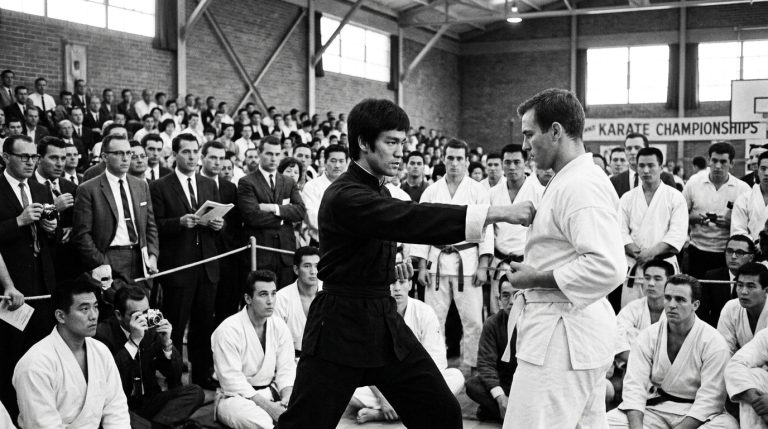
In 1965, Bruce Lee went looking for a fight and found one he wasn’t prepared for. His encounter with Wong Jack Man — a formal challenge issued by a group of Chinese martial artists who objected to Lee teaching kung fu to non-Chinese students in Oakland — ended in Lee’s victory, but not quickly enough to satisfy him. He won, but the fight took three minutes. By his own reckoning, it should have taken thirty seconds.
The experience became a turning point in how he thought about physical training. If his technique was that superior, why was he gassing out? The answer led him directly to the weight room — a place that most martial artists of the era treated with suspicion.
The Orthodoxy He Rejected
In the early 1960s, the mainstream martial arts view of weight training was unambiguous: lifting heavy made fighters slow, inflexible, and dependent on strength over skill. The term “muscle-bound” was used as a genuine medical description, not just a cliche. Classical kung fu and Japanese karate teachers taught that their systems produced complete fighting capability without any supplementary strength work. Weights were for bodybuilders, not fighters.
Lee read widely enough to recognize this as dogma without adequate evidence. The fighters condemning weight training had never systematically tested it. They were repeating received wisdom. He wasn’t interested in received wisdom. He was interested in what actually worked.
He began incorporating barbells and dumbbells into his training and immediately noticed the gap between the theoretical concern about becoming “muscle-bound” and the actual results. Intelligently programmed resistance training made him faster, not slower. It improved his punching power measurably. The key, which most critics of weight training had missed, was that the training had to be designed for athletic performance — not for hypertrophy, not for maximum weight on the bar.
Core Metric: Power-to-Weight Ratio
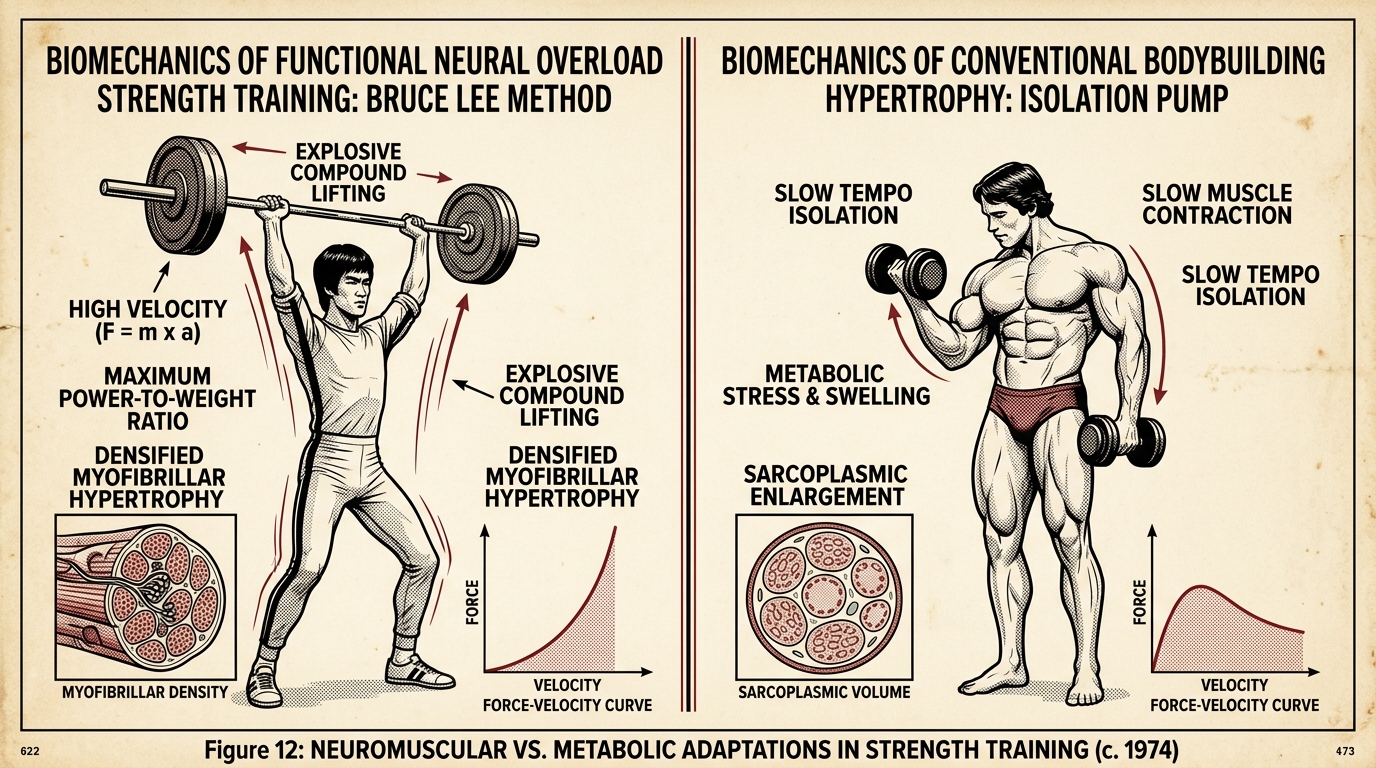
In the mid-1960s, traditional martial artists avoided weights, fearing muscle-binding. Lee proved that intelligent weight training enhances speed, provided lifting focuses on neural recruitment rather than cosmetic volume.
The 1970 Back Injury: Forced Reset
In August 1970, Lee’s training was derailed violently. While performing good mornings — a barbell exercise targeting the lower back and hamstrings — with improperly loaded weight and compromised form, he suffered a severe sacral nerve injury. Specifically, he damaged the fourth sacral nerve. The injury left him bedridden for months and caused pain that followed him for the rest of his life.
Doctors told him he might never practice martial arts at the level he had again. He was 29 years old. This part of his biography is explored in detail in his comprehensive biography, but what gets less attention is how he used the enforced inactivity. Unable to train, he read. Sports science journals, physiology textbooks, biomechanics research. The intellectual foundation of the training system he built afterward was assembled during those months of recovery.
The injury also forced him to be honest about the limits of his prior approach. He had been training hard without always training intelligently. The rebuilt system that emerged from recovery was far more sophisticated — with specific attention to form, recovery periods, and the relationship between different types of training.
The Program: What He Lifted and Why
| Compound Exercise | Target Musculature | Sets & Repetitions | Functional Combat Transfer |
|---|---|---|---|
| Clean and Press | Posterior Chain, Traps, Deltoids | 2 sets × 8–12 reps (70–80 lbs) | Explosive triple extension from ground to overhead; kinetic chain linking. |
| Barbell Full Squat | Quadriceps, Glutes, Lumbar Base | 2 sets × 12–20 reps (95–140 lbs) | Spring-loaded lower body drive for forward thrust and explosive stance shifts. |
| French Press (Lying Extension) | Triceps (Medial & Lateral Heads) | 2 sets × 6–8 reps (60–70 lbs) | Terminal lockout snapping force behind straight lead punches and backfists. |
| Barbell Curl | Biceps Brachii & Brachialis | 2 sets × 8 reps (70–85 lbs) | Forearm flexion integrity and pulling control during close-range trapping. |
| Weighted Push-Ups | Pectorals & Serratus Anterior | 3 sets to failure | Scapular stability and explosive pushing velocity without shoulder impingement. |
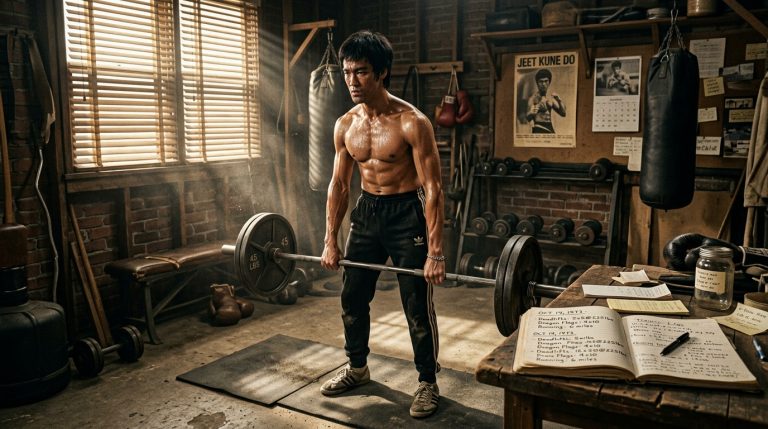
Lee’s weight training, as documented in his personal notebooks and later compiled by John Little, followed a three-days-per-week structure alternating with cardiovascular work and martial arts practice. The exercises were selected for direct transfer to fighting performance, not aesthetic outcomes:
- Barbell curl — 3 sets x 8 reps. Primary bicep development for elbow flexion strength in clinch situations and trap/pull techniques.
- French press (lying tricep extension) — 3 sets x 8 reps. Tricep strength contributes directly to punching extension speed and lock-out power.
- Concentration curl — 4 sets x 6 reps. Peak-contraction focus, developing the high point of bicep engagement that full-range curls sometimes miss.
- Dumbbell kickback — 3 sets x 8 reps. Tricep isolation through full extension range.
- Reverse curl — 4 sets x 6 reps. Targets brachioradialis and the extensor muscles of the forearm, directly relevant to grip and wrist control.
- Wrist curl / reverse wrist curl — 4 sets x 6 reps each. Part of a broader forearm development program documented separately in his wrist and forearm training work.
- Bench press — 3 sets x 6 reps. Chest and anterior shoulder pressing strength, contributing to push-off power in clinch and the driving force of certain strikes.
- Squat — 3 sets x 8 reps. Leg strength foundation. Lee understood that lower body power fed into everything above it through the kinetic chain.
The rep ranges — 6 to 8 — were deliberately chosen to develop strength rather than hypertrophy. Higher rep ranges (12+) primarily develop muscular endurance and volume. Lee wanted dense, strong muscle that added minimal weight while maximizing force output. The sets were moderate. The rest periods were controlled. He trained to technical failure — meaning he stopped when form began to degrade, not when he physically couldn’t complete another rep.
I do not train to build muscle mass; I train to cultivate functional neuromuscular explosiveness. Real power is speed in action.
Bruce Lee, Interview with Black Belt Magazine (1967)
The Principle: Strength That Transfers
Lee’s approach to weights was governed by a principle he returned to constantly in his notebooks: strength that doesn’t transfer to performance is useless for a fighter. This sounds obvious stated plainly, but it contradicted the bodybuilding culture of the period, which valued the development of individual muscles for aesthetic purposes regardless of functional application.
This is why he also incorporated isometric training — static contractions held against immovable resistance — alongside his conventional lifting. Isometric work develops strength at specific joint angles, including the angles most commonly held in fighting positions. A punch, a guard position, a clinch — these involve sustained tension at fixed positions. Isometrics train exactly that, in a way that dynamic lifting can’t replicate.
He also used his training journals to track progress meticulously. Weights used, sets completed, how the workout felt, what needed adjustment. This level of documentation was unusual for athletes of his era and reflects his broader approach to self-development: nothing was left to intuition when it could be tracked and optimized.
The Results
By 1972 — two years after the back injury that was supposed to end his career — the physique Lee displayed during Enter the Dragon filming was unlike anything audiences had seen from a martial artist. The arms were dense and striated without being bulky. The chest was powerful but not barrel-chested. The forearms were disproportionately developed — a direct result of the specific grip and wrist work he’d prioritized for years.
Production crew members from that shoot consistently described him as physically extraordinary in ways that went beyond appearance. He was moving equipment trailers that required two people, demonstrating striking power that knocked people off their feet despite his size, and maintaining that output across twelve-hour shooting days without obvious fatigue.
Weight training did not make Bruce Lee a martial artist. But it made the martial artist he already was significantly more capable. The willingness to test that assumption — against the consensus of every traditional system he’d been trained in — was as characteristic of him as anything else in his story.