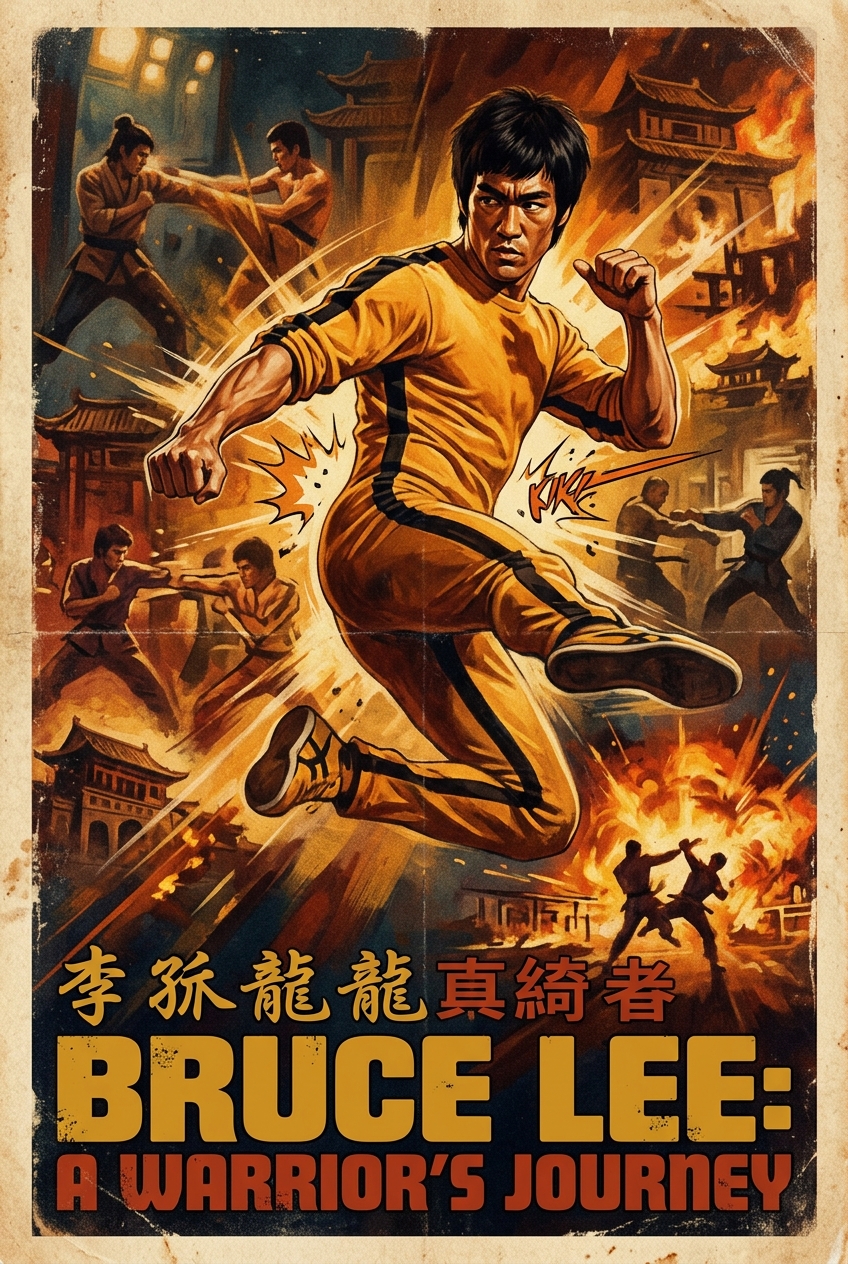
Bruce Lee: A Warrior’s Journey (2000)
Directed by: John Little | Studio: Warner Bros. | Runtime: 95 minutes | Released: October 10, 2000
There’s a film inside Game of Death that the world never got to see. Bruce Lee shot roughly 40 minutes of original pagoda footage in 1972 before he paused production to make Enter the Dragon. He was dead within a year. Bruce Lee: A Warrior’s Journey is the closest thing to a restoration of that lost vision, and it remains the most important documentary made about Lee as a filmmaker rather than a celebrity.
What the Film Actually Is
Produced by Warner Bros. and directed by John Little, a martial arts historian who spent years studying Lee’s notebooks and personal writings, A Warrior’s Journey does two things simultaneously. The first half is a conventional documentary exploring Lee’s philosophy, his concept of Jeet Kune Do, and the artistic vision he brought to his film work. The second half is something rarer: the surviving footage from Lee’s original Game of Death shoot, presented in reconstructed form and shown without the 1978 film’s clumsy overlay of a different plot and a different actor.
That second half is essential viewing for anyone serious about Lee’s legacy. The pagoda fights were never just action sequences. Lee designed each encounter as a demonstration of a martial arts principle: the guardian on each floor represents a different fighting doctrine, and Lee’s character must abandon fixed technique in favor of adaptive, instinctive response. It’s Jeet Kune Do as cinema.
The Three Pagoda Fights
The footage Little assembled centers on three confrontations that rank among the most technically accomplished fight scenes Lee ever filmed.
- Dan Inosanto (Floor 3): Lee’s own student, a Kali and nunchaku specialist, faces off against his teacher in an exchange that is genuinely mutual. Inosanto holds his own for longer than any other opponent Lee ever filmed. The speed of both men is extraordinary.
- Ji Han-Jae (Floor 4): A Korean hapkido master. This fight takes place at close range and involves throws, joint manipulation, and grappling in a way that none of Lee’s theatrical films approached. It was supposed to show that Lee’s method worked against a grappling specialist.
- Kareem Abdul-Jabbar (Floor 5): The NBA center at 7’2″ versus Lee at 5’7″. Lee choreographed this deliberately as an almost surreal physical contrast. Abdul-Jabbar had trained with Lee for years before the shoot. The sequence uses shadow and light in a way that feels more like European art cinema than a kung fu film.
John Little’s Reconstruction
Little worked from approximately 32 minutes of raw, unedited Golden Harvest vault footage that surfaced in 2000. He also drew on Lee’s own production notes and storyboards to sequence the material as Lee intended. The reconstruction isn’t perfect, it can’t be. Some floors of the pagoda were never filmed at all. But what Little assembled is coherent and illuminating in ways the 1978 theatrical release never attempted to be.
What the documentary makes undeniable is that Lee was on the verge of making something genuinely original. This wasn’t a run-of-the-mill martial arts film with a bigger budget. It was a conceptual piece about the nature of combat and adaptability, told through action. The gap between what Lee intended and what the world got from the compromised 1978 release is one of cinema’s genuine losses.
Critical Reception and Legacy
A Warrior’s Journey received strong reviews from martial arts historians and Bruce Lee scholars when it released in 2000. It was not a mainstream theatrical release, but it found a dedicated audience through DVD. For many serious fans, it replaced the 1978 Game of Death entirely as the definitive version of that project.
The documentary also prompted renewed academic and journalistic attention to Lee as an artist. His notebooks, published in volumes like The Tao of Jeet Kune Do and Artist of Life, had always suggested a far more intellectually rigorous mind than the Hollywood mythology acknowledged. A Warrior’s Journey put that intelligence on screen in a way that was impossible to dismiss.
Cast (Original Pagoda Footage)
| Actor | Role |
|---|---|
| Bruce Lee | Hai Tien |
| Dan Inosanto | Floor 3 Guardian |
| Ji Han-Jae | Floor 4 Guardian |
| Kareem Abdul-Jabbar | Floor 5 Guardian (Hakim) |
| Casanova Wong | Floor 2 Guardian |
Watching A Warrior’s Journey doesn’t leave you satisfied. It leaves you wondering. Lee was 32 when he died, and the pagoda footage he shot represents perhaps 40 minutes of a film that would have been 90 to 100 minutes. What’s missing isn’t incidental. It’s the second half of a thought we’ll never hear finished.